
Alfred Hitchcock completed over sixty films in a career spanning six decades. His work is full of iconic and unforgettable scenes so firmly embedded in popular culture that everyday things like birds, trains, and shower curtains can conjure them.
Join us on October 28th for an evening of classic horror from the one and only "Master of Suspense." We'll announce the film closer to the date, but rest assured — it will be classic and thrilling.
Your movie ticket includes 1900 snacks, beverage and a great time. There is an option for a ticket with an adult beverage and without.
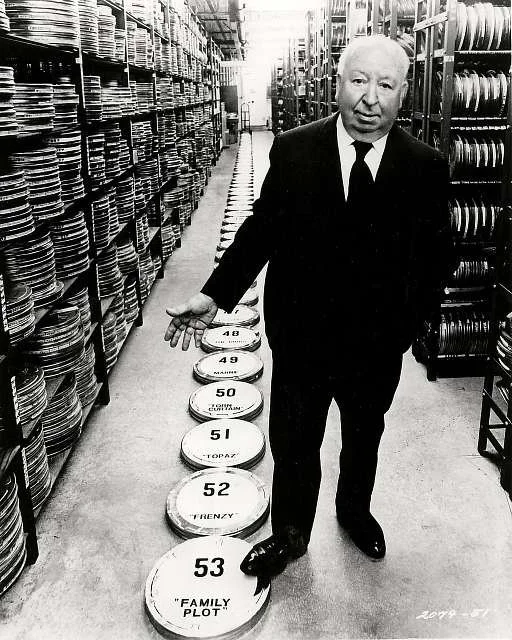
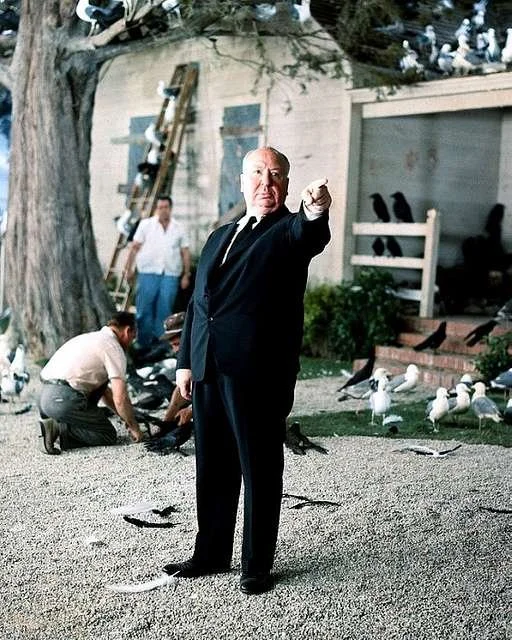
Alfred Hitchcock was born in Leytonstone, England on August 13, 1899. He was the youngest of three children born to William and Emma Jane Hitchcock.
After attending a technical school at 15, Hitchcock spent the first years of his career as a draftsman, advertising designer, and writer. An interest in photography led to him working in London's film industry, first as a title card designer for silent movies and, just five years later, as a director.
In 1926, Hitchcock married his assistant director, Alma Reville, and in 1928 they had a daughter, Patricia.
Hitchcock quickly gained notoriety as a director who delivered suspense, twist endings, and dark subject matter. His own personality and gallows humor were embedded in popular culture through interviews, film trailers, and cameo appearances in his own films. He was popular with audiences at home and abroad, and in 1939 the Hitchcock family moved to Hollywood. In the three decades that followed he would cement his legacy by directing and producing his most successful and enduring works. His television anthology, Alfred Hitchcock Presents, ran from 1955 to 1965 and made him a household name.
Alfred Hitchcock is often remembered as the singular “Master of Suspense,” a visionary whose name became synonymous with psychological tension and cinematic control. Yet this image, while compelling, is incomplete without acknowledging the profound and often understated influence of his wife, Alma Reville.
Alma was deeply embedded in the filmmaking process from the very beginning. Trained in editing, writing, and continuity, she possessed a technical fluency that complemented Hitchcock’s directorial instincts. Their collaboration was not casual or occasional—it was foundational. She read scripts, offered structural critiques, refined dialogue, and helped troubleshoot narrative problems long before cameras began rolling.
What made Alma’s role particularly vital was her ability to act as both a creative sounding board and a critical counterbalance. She had a sharp sense of pacing and character logic, ensuring that the emotional core of a film was never lost amid stylistic ambition. She functioned as an invisible editor of Hitchcock’s imagination, quietly shaping the films audiences would later praise as masterpieces.
She was not only a collaborator but also a stabilizing force—someone who understood both the artistic and practical demands of filmmaking.
Despite this, Alma’s contributions were largely uncredited or minimized, reflecting broader patterns in the industry at the time, where women’s creative labor was often overlooked. To recognize her importance now is not simply to “give credit where it’s due,” but to reconsider the myth of solitary genius in filmmaking. Hitchcock’s success was not the product of isolation, but of collaboration—one in which Alma played a central, indispensable role.
Bio via AlfredHitchcock.com